In this article
Rot is the reason most sash windows are condemned, and the reason most of those condemnations are wrong. A soft patch on a sill looks alarming, and a screwdriver pushed into it by someone selling replacement windows looks worse. But decay in a timber window is almost always local — it starts in one or two predictable places, for predictable reasons, and a joiner who understands why it started can cut it out, replace it with new timber and leave a window that will outlast a replacement.
This article explains the mechanics: what rot is, where it takes hold in a box sash window and why, how to find it, what the repairs involve, and the small number of cases where the honest answer is a new window. It draws on the work we do every week on Victorian and Georgian windows across Leicestershire, Nottinghamshire, Birmingham and Lincolnshire.
What rot actually is
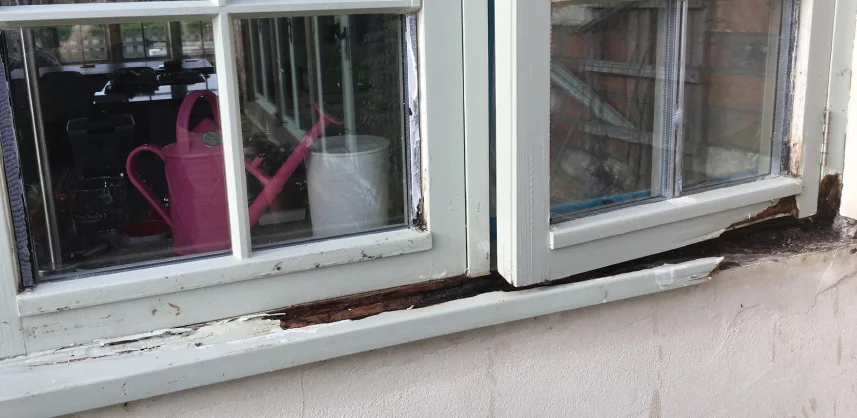
The rot in windows is fungal. Wet rot — most often a fungus called Coniophora puteana, the cellar fungus — needs timber that stays wet, with a moisture content above about 20 per cent for long periods, and it needs oxygen and a temperature it likes, which in England is most of the year. Give it those and it digests the cellulose in the wood, leaving the timber dark, soft, cracked into cubes along and across the grain, and eventually crumbling.
Dry rot — Serpula lacrymans — is a different and more serious organism, but it is rare in windows. It needs still, damp, unventilated conditions and it spreads through masonry; a window sill in the open air is not its habitat. If someone tells you a window has dry rot, be sceptical.
The important thing about wet rot is what it does not do. It does not spread through dry timber. It stops where the moisture stops. That is why decay in a sash window is local, and why a repair that removes the decayed timber and, crucially, removes the reason it got wet is a permanent repair.
Where it starts, and why
Water gets into a sash window in a handful of ways, and each produces its own pattern of decay.
The sill
The sill is the sloping timber at the bottom of the box. It takes every drop of rain that runs down the glass and the sashes, it faces the sun, and it has exposed end grain at both ends where it enters the brickwork. Decay starts at the front edge, where the paint fails first and water sits, and at the ends, where end grain draws water up like a straw. A sill that has lost its paint on the top surface will start to check — fine cracks across the grain — and every check holds water. On a house where the pointing under the sill has gone, water can also get behind and under it.
The bottom rail of the lower sash
The bottom rail sits on the sill and collects water running down the inside and outside faces of the glass. Its lower edge is often in contact with a wet sill, and the joint between the rail and the stiles at each corner opens with age, letting water into the end grain of the rail. Decay starts at the corners and at the glazing rebate, where the putty has shrunk away from the glass and water runs behind it.
The feet of the pulley stiles
The vertical sides of the box are usually the soundest part of the window, protected by the sashes and beads. The exception is the bottom few inches, where they sit on the sill: if the sill has been wet for years, the stile feet wick water up and rot from the bottom.
The meeting rail and the top rail of the upper sash
Less common, but the upper sash's top rail sits against the head of the frame, where a failed lintel or a leaking gutter above can keep it wet, and the meeting rail collects condensation on the inside in a cold room.
Glazing bars
Thin, with putty on the outside face and a tiny section of timber behind it. Once the putty cracks, water sits in the rebate and the bar decays from the outside in. This is the one place where decay can become general rather than local, because there are so many joints.
The common thread
Every one of these starts with a maintenance failure: paint that was allowed to go, putty that was allowed to crack, a gutter or a sill joint that was allowed to leak. The timber did not fail; the coating did. That is the practical point of this whole article — a Victorian window kept painted and puttied does not rot, and a window that has started to rot is stopped by fixing the coating along with the timber.
Finding decay before it spreads
You do not need instruments, though a moisture meter helps. You need a bradawl or a small screwdriver and a methodical habit.
- Look first. Paint that has lifted, blistered or flaked is the earliest sign, especially on the sill and the bottom rail. Dark staining under the paint film, or paint that looks sound but is bridging a crack, means wet timber underneath.
- Press. Push the tool into the sill at each end, along the front edge and in the middle; into the corners of the bottom rail; into the foot of each stile; along each glazing bar at the joints. Sound timber stops the point almost immediately. Decayed timber lets it in, softly.
- Tap. Sound timber gives a sharp knock; decayed timber a dull one. It is surprisingly reliable once you have heard both.
- Check the cause. Look up: is there a gutter overflowing above the window? Look down: is the pointing under the sill sound, and does the sill throw water clear of the wall? Look at the putty: is it cracked, shrunk, or missing?
Map what you find on each window before anyone quotes. A sill soft at one end and a bottom rail soft at one corner is a small repair. A sill soft from end to end is a sill replacement. Stiles soft for more than a few inches above the sill is a box repair, and that is where the conversation about replacement legitimately begins.
How the repairs are done
Splice repairs
The standard repair for localised decay. The decayed section is cut out square, back to sound timber — and then a little further, because the fungus is present a short distance beyond the visibly rotten wood. A new piece of timber is cut to match, ideally a dense softwood such as Douglas fir or a slow-grown redwood, or Accoya where the exposure is severe. It is let in with a scarf or a stepped joint that gives plenty of glue area, bonded with a waterproof exterior adhesive and secured with stainless-steel screws set below the surface and plugged. The joint is then planed flush, the profile of the sill or rail re-formed with a plane and a moulding cutter, and the whole thing primed.
The critical detail is the direction of the joint: it must be cut so that water running down the face of the window runs away from the joint line, not into it. A splice cut the wrong way is a future rot pocket.
Resin repairs
Where decay is shallow — a few millimetres deep over a wide area, typically on a sill top surface that has checked — a two-part epoxy repair system is the right tool. The soft timber is removed back to sound wood, the surface is treated with a low-viscosity epoxy consolidant that soaks into the fibres and hardens them, and the profile is built back with an epoxy filler that can be planed and sanded like wood and holds paint. Done properly, a resin repair is durable and invisible. Done as a substitute for cutting out real decay — filler pushed into a hole in soft wood — it fails within a year or two, which is why "filler" has a bad name.
The rule of thumb: if the decay is deeper than about 10 to 15 mm or reaches a joint, cut it out and splice; if it is shallow surface decay, consolidate and fill.
New sills
A sill decayed along its full length is replaced. With the sashes out and the beads off, the old sill is cut through and removed from the box, the stile feet are checked and spliced if needed, and a new sill is made to the original section — with the same weathering slope, the same drip groove underneath and the same projection — and fitted into the box with the stiles housed into it as the original was. The joint between the new sill and the brickwork is pointed. The window stays in the wall throughout.
New bottom rails and stiles
A sash with a rail or stile decayed along its length gets a new one. The sash is taken to the workshop, the joints are knocked apart, the decayed member is replaced with a new one cut to the same section and jointed in the traditional way, and the sash is glued up square, reglazed and returned. A temporary board keeps the opening secure meanwhile.
Glazing bars
Decayed bars are replaced with new bars machined to the exact original profile — the moulding on a Georgian bar is part of the window's identity — and the sash is reglazed with new putty or, where it suits the building, glazed with a putty alternative that stays flexible.
Fixing the cause
None of this is finished until the reason for the water is dealt with: the gutter cleared or repaired, the pointing under the sill renewed, the putty replaced everywhere it has failed, and the whole window repainted with a proper exterior system — primer on bare timber, undercoat, two top coats, the paint carried a couple of millimetres onto the glass to seal the putty line. The paint is the repair that stops the next repair.
A word on old paint
Stripping paint from a pre-1980s window means assuming lead is present in the older layers. Lead pigments were common in domestic paint until the 1960s and were not fully out of ordinary paints until the early 1980s, and the ban on lead paint in the UK only came in 1992. The hazard is dust, so the rule is no dry sanding: use a heat gun kept below 500 °C, a chemical stripper or wet abrasion, contain the debris, and keep children and pregnant women away from the work. A good firm does this as a matter of course.
When a window is genuinely beyond repair
There are three honest cases.
The box has rotted. If the pulley stiles are decayed for most of their height, or the head is gone, water has been getting in behind the window for a very long time — usually from a failed lintel, a leaking gutter or a cracked render band above. The box has to come out. Even here the right answer is a new box sash window made to the original pattern, not a different kind of window.
Decay is general rather than local. A sash where the bottom rail, both stiles, the meeting rail and half the glazing bars are soft is a sash to remake, not to splice in six places. New sashes in the existing box is still a repair to the window.
The cost of repair approaches the cost of a new sash. This is a judgement, and it is one we make on the survey. Where three or four separate repairs on one sash add up to more than a new sash made to match, we say so.
What none of these means is that the window has to be replaced with something different. Timber like for like, to the original section and pattern, is almost always the right replacement — and in a conservation area or on a listed building it is usually the only one that will be allowed.
Keeping the repair repaired
A restored window needs the same thing the original needed and did not get: paint. Inspect the sills and bottom rails every couple of years; touch up any chip or crack in the paint as soon as it appears, because that is where water gets in; keep the gutters clear; and repaint the exterior every six to eight years, or sooner on a south- or west-facing elevation that takes the weather. A window looked after this way does not rot again.
Frequently asked questions
Can a rotten sash window sill be repaired?
Yes, in almost every case. Localised decay is cut out and new matched timber spliced in; shallow surface decay is consolidated with an epoxy system; a sill decayed along its full length is replaced in one piece with the window still in the wall. All three are standard repairs.
Is wood filler a proper repair for rot?
Only when used as part of an epoxy repair system on decay that is shallow — a few millimetres — and after the soft timber has been removed and the surface consolidated. Filler pushed into a hole in soft wood fails quickly. Decay deeper than about 10 to 15 mm, or at a joint, is cut out and spliced.
Does wet rot spread to the rest of the window?
Not through dry timber. Wet rot needs a moisture content above roughly 20 per cent, so it stops where the wood is dry. That is why decay in a sash window is usually confined to the sill, the bottom rail and the stile feet, and why a repair that removes the decay and stops the water is permanent.
How can I tell if a window is beyond repair?
Press a bradawl into the sill, the bottom rail corners, the foot of each stile and the glazing-bar joints. Soft patches in one or two places are repairs. Stiles soft for more than a few inches above the sill, or a sash soft in most of its members, are the cases where a new box or new sashes are the sensible answer — still made in timber to the original pattern.
Why did my sash windows rot in the first place?
Because water was allowed to stay in the timber — through failed paint, cracked putty, a leaking gutter, pointing gone under the sill or a sill that no longer throws water clear. The timber itself is rarely the problem; Victorian softwood is denser and more durable than most modern joinery timber.
What timber is used for repairs?
A dense softwood that matches the original — Douglas fir or a slow-grown redwood — or Accoya, a modified timber with very high rot resistance, where the exposure is severe. Whichever is used, the section and mouldings are matched to the original so the repair disappears under paint.
How often should sash windows be repainted?
Every six to eight years for the exterior, sooner on elevations that face the weather. More important than the interval is touching up any damage to the paint film promptly, because every chip is a point where water gets into the timber.